
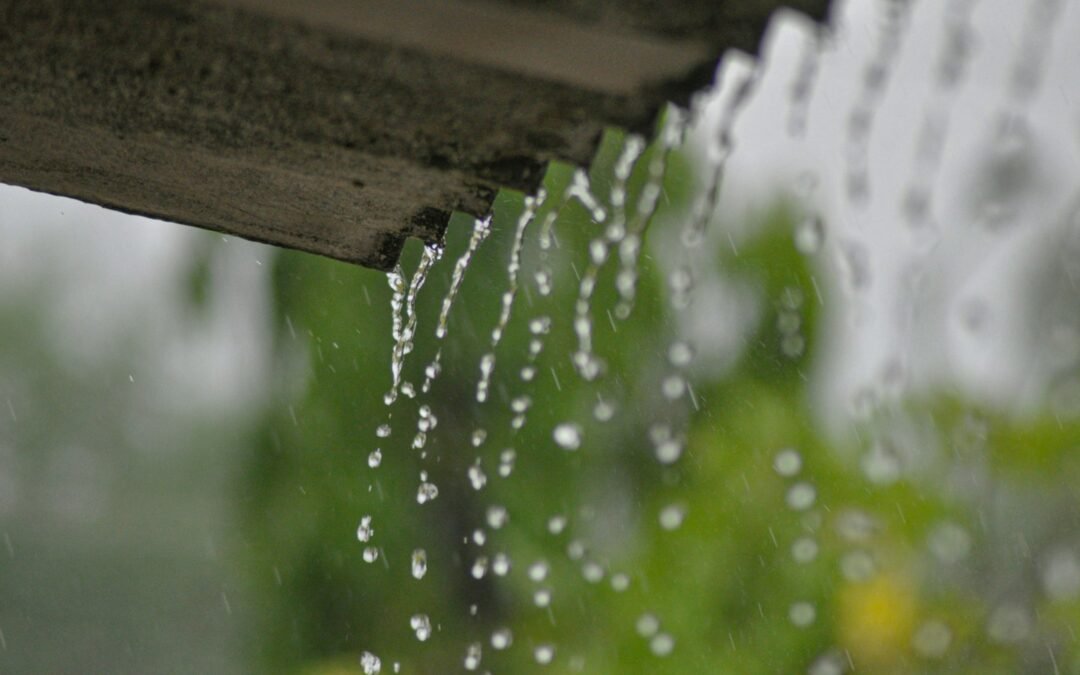
Most conversations about gutters stop at the gutter. Clogs and sags matter, but they only cover the first few feet of a much longer trip. Every drop of rain that hits your roof has to end up somewhere, and in a wet Western Washington month that is a startling amount of water. If it ends up beside your foundation, the gutters did not really do their job. Here is how we think about the whole path, from shingle to soil.
How Much Water Are We Talking About?
The math is simple and the result surprises people. A single inch of rain on a 2,000-square-foot roof produces well over a thousand gallons of runoff. Everett and Bothell get several inches of rain in November alone, and an atmospheric river month delivers considerably more. Over a winter, a typical Puget Sound roof sheds tens of thousands of gallons, and every one of them arrives at the bottom of a downspout.
Now picture that downspout ending six inches from the foundation, or worse, ending in a tight-line drain that collapsed 20 years ago. The water goes straight down along the foundation wall, into the crawlspace, or under the slab. That is where basement dampness, musty crawlspaces, white mineral deposits on concrete, and settling cracks begin.
Downspout Sizing and Placement
The gutter is only as good as the downspouts draining it. A long run of gutter with a single small downspout will overflow in heavy rain long before the gutter itself is at fault. When we install extruded seamless gutters, we size the downspouts to the roof area feeding them and place them so no section of gutter carries more water than it can drain. On larger roofs or steep pitches that shed water fast, that often means more downspouts or larger ones than the house originally had.
Downspouts also need to stay connected. One that has separated at an elbow dumps water down the siding, and one crushed near the ground backs up and overflows behind the gutter into the fascia.
Splash Blocks and Extensions
The simplest tool in the whole system is also the most neglected. A splash block or a downspout extension carries water a few feet away from the foundation before it soaks in. That distance is the difference between water draining away through the yard and water pooling against the house.
Splash blocks get kicked out of line by lawnmowers, buried by bark, and tilted backward by settling soil so they actually direct water toward the house. Checking that each downspout ends on a block or extension that slopes away from the house is one of the highest-value ten minutes a homeowner can spend.
Tight-Line Drains and the Old Drain Tile Problem
Many homes route downspouts into underground pipes that carry water to the street, a storm drain, a dry well, or a low point in the yard. When these tight-line systems work, they are the best solution, because the water leaves the foundation entirely. When they fail, the failure is invisible.
In older neighborhoods across Kirkland, Edmonds, and Tacoma, the original drains were often clay or concrete tile, or thin corrugated plastic that has since crushed, filled with roots, or silted shut. But the water is now backing up in the pipe and coming out at the foundation, or pooling under the crawlspace vapor barrier.
Warning signs include water bubbling up at the downspout base during heavy rain, a gutter that overflows only near one downspout, standing water in the crawlspace, and persistent dampness on one side of the house. A drain contractor can run a camera through the line to confirm. When we replace gutters and find a suspect drain, we tell you, because new gutters feeding a dead drain are not solving anything.
The Crawlspace Connection
Most Puget Sound homes sit over a crawlspace, and crawlspaces are where roof drainage problems reveal themselves. Water that drains against the foundation seeps through, collects on the vapor barrier or the soil, and evaporates upward into the house. The results are musty smells, high indoor humidity, mold on floor joists, and insulation that sags with moisture.
When we inspect gutters, we look at where the water goes after it leaves them. A gutter system that drains perfectly into a puddle at the foundation is not finished.
Thinking About the Whole Water Path
Roof, gutter, downspout, extension or drain, and finally somewhere safe for the water to go. Each link depends on the one before it. Seamless gutters eliminate the leaky joints that drip along the foundation. Gutter guards, as an optional upgrade, keep the fir needles that clog downspouts out of the system in the first place. Skip any link and the water finds the weak spot, usually right where it does the most damage.
Let Us Look at the Whole System
Premier Roofing NW has been installing and repairing extruded seamless gutters across the Greater Puget Sound area for more than 30 years, and we look at downspouts, splash blocks, and drainage as part of every gutter estimate, not as an afterthought. Inspections and estimates are free, with no pressure. Discounts are available for seniors, military, and first responders; just ask when scheduling. Call us at (425) 247-0088 and we will make sure your roof water ends up where it belongs, away from your house.