
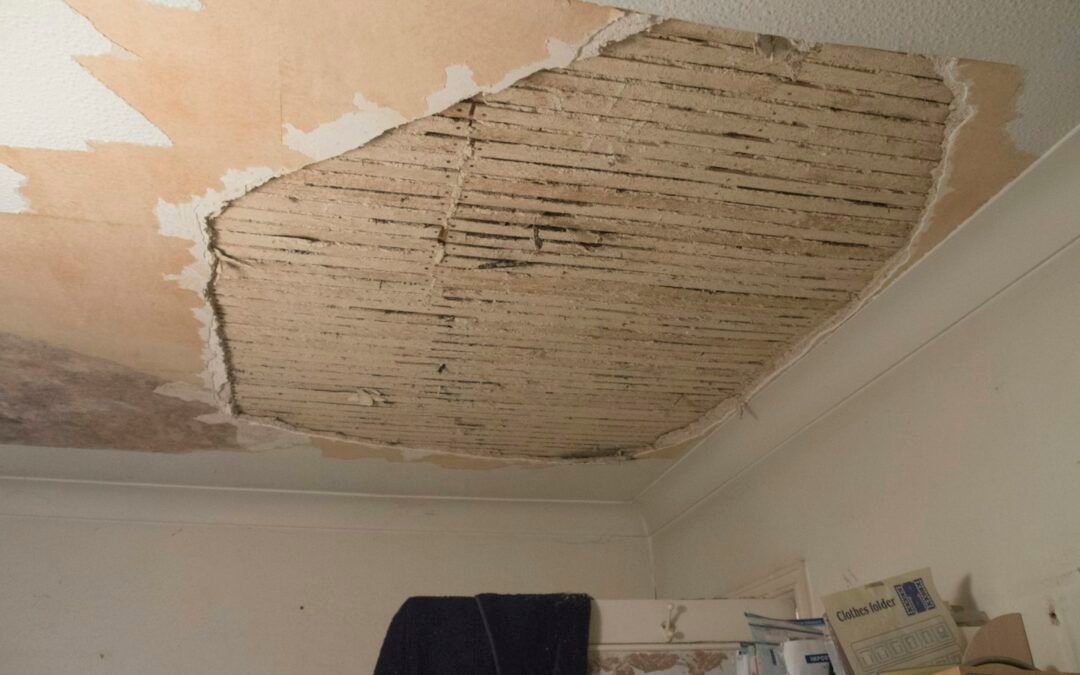
An atmospheric river has been parked over Western Washington for three days, the ceiling in a Bothell or Puyallup bedroom has a stain that was not there last week, and the homeowner has one question: what do I do now? The honest answer has three parts, and they happen in order. First you stop the water. Then you find out what is actually wrong. Only then do you decide between a permanent repair and a replacement conversation. Here is how we walk homeowners through each step.
Step One: Stop the Water Today
A leak in November will not get a dry week to wait for. The first job is to protect the house, not to fix the roof. Inside, move furniture, put a bucket under the drip, and if the ceiling is bulging, poke a small hole at the low point so it drains into the bucket instead of spreading across the drywall.
Outside, the temporary fix depends on what is leaking. A lifted shingle or a small flashing gap can often be sealed with roofing cement or a peel-and-stick patch for a few weeks. Larger damage, like a missing section of shingles after a windstorm or a branch through the deck, needs a tarp secured over the ridge and down past the damaged area. We do emergency tarping for exactly this situation, and we would rather you call us than climb a wet roof in the dark. A temporary fix is a bandage that buys time for a good decision instead of a rushed one.
Step Two: Diagnose It on a Dry Window
Water rarely comes through the roof where it shows up on the ceiling. It runs down rafters, along underlayment, and across the top of insulation before dripping, sometimes ten or fifteen feet from the actual entry point. Diagnosing a leak properly means getting on the roof when it is dry enough to walk, and tracing the water trail in the attic back to its source.
Western Washington gives us those dry windows even in November, usually a day or two between fronts, and we schedule inspections into those gaps. What we find usually falls into a handful of categories: flashing that has pulled away at a chimney or wall, a cracked pipe boot, a nail pop, a valley where fir needles have backed water under the laps, or shingles that have simply reached the end of their life and are letting water through in several places at once.
When a Permanent Repair Is the Right Call
Most November leaks are repairs, not replacements. If the roof is under 15 or so years old, the shingles are still flexible and holding their granules, and the leak traces to one identifiable failure, a permanent repair is the right answer. Replacing a pipe boot, resealing and refastening step flashing, or swapping out a dozen damaged shingles is work our crews do all winter in Everett, Kirkland, and everywhere between.
Repairs can be done in wet weather. We need the surface dry enough for sealants to bond, which may mean waiting for a morning break in the rain, but not a sunny week. A good repair on a sound roof should last as long as the roof itself, and we back our workmanship.
When the Leak Is the Roof Telling You It Is Done
Some leaks are not really leaks. They are symptoms. If the roof is 20 to 25 years old, if we find granule loss across whole slopes, if shingles crack when we lift them to check the fasteners, or if there is a second active leak elsewhere, then patching the one spot you noticed is spending money on a roof that will produce another leak in the next atmospheric river. We will tell you that plainly, then give you a written estimate for replacement and a realistic timeline.
Replacement in late fall is more possible than most homeowners assume, because we tear off only what we can dry in the same day. Some homeowners choose a solid temporary repair now and schedule the full replacement for a dry stretch in winter or early spring.
What Can Wait for Spring, and What Cannot
It cannot wait if water is actively reaching insulation, drywall, or framing, because wet insulation and wet wood in a closed attic grow mold and rot within weeks, not months. It cannot wait if the leak is near electrical fixtures, or if a tarp is the only thing between your attic and a November windstorm.
It can often wait, with a proper temporary repair in place, if the leak is minor, the source is confirmed, and the fix is holding through a couple of storms. Whatever you decide, do not let a temporary fix become a permanent one. Tarps degrade in a few months, and roofing cement fails as it ages.
Get a Straight Answer on Your Leak
If your ceiling has a new stain this month, call us. Premier Roofing NW has handled 30+ years of Puget Sound wet seasons, from Puyallup to Marysville, and our inspections and estimates are free. We will stop the water, find the real source on the next dry window, and tell you honestly whether you are looking at a repair or a replacement. Discounts are available for seniors, military, and first responders, just ask when scheduling. Call us at (425) 247-0088.