
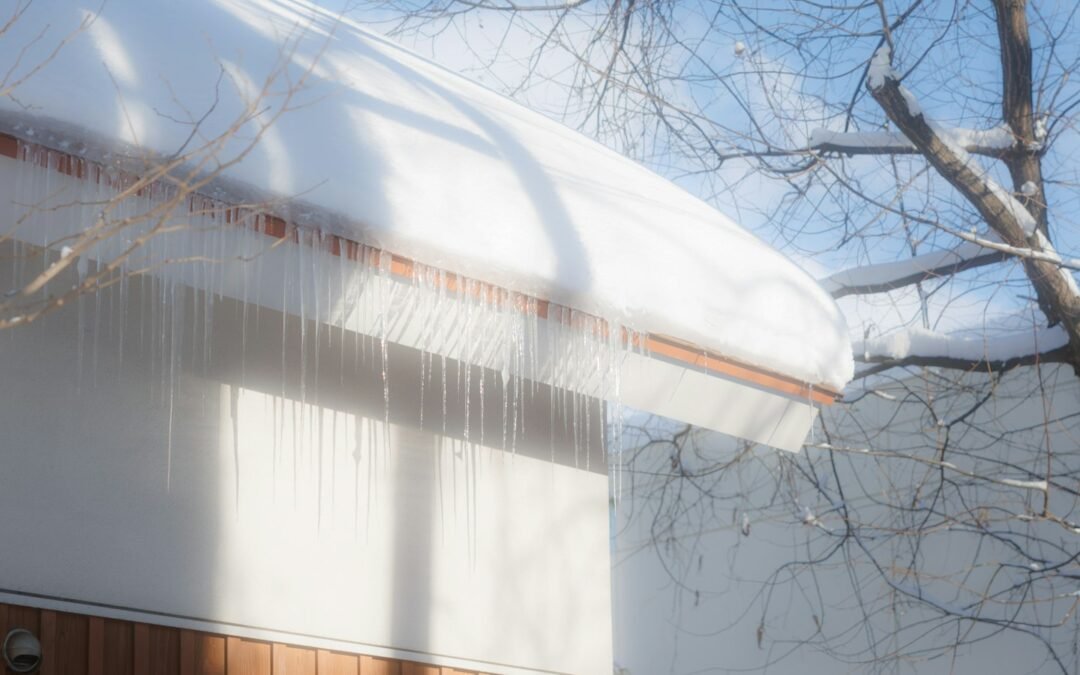
Ask most homeowners in Seattle or Edmonds and you will get a blank look, because at sea level in the Puget Sound lowlands, an ice dam is a rare event that needs a specific cold snap to happen at all. But our service area does not stop at sea level. Drive east on Highway 2 toward Gold Bar, up the Mountain Loop Highway past Granite Falls, or out I-90 to North Bend and Snoqualmie, and the winter changes. Snow sticks. Cold spells last. And ice dams go from a curiosity to a real and recurring cause of roof damage.
How an Ice Dam Forms
An ice dam is the product of a roof that is warm in the middle and cold at the edges. Snow lands on the roof. Heat escaping from the house through the attic warms the underside of the roof deck over the living space and melts the bottom layer of snow. That meltwater runs down the slope under the snowpack until it reaches the eave, which hangs past the exterior wall and gets no heat from below. There it refreezes.
Do that for a few days and a ridge of ice builds along the eave. Meltwater coming down behind it has nowhere to go, so it pools against the ice, backs up under the shingles, and finds its way through the roof deck. Shingles are designed to shed water running downhill. They are not designed to hold standing water pushed uphill by a wall of ice. The result is soaked attic insulation, stained ceilings along exterior walls, wet drywall above windows, and, after a few winters, rotted decking and fascia at the eaves.
Where It Happens in Our Region
In the lowlands, snow rarely lasts long enough for the cycle to build. A weeklong Arctic outbreak can produce them in Lynnwood or Bellevue, but most winters pass without one.
The foothills are different. Snoqualmie, North Bend, Gold Bar, Granite Falls, and the higher parts of the Issaquah and Sammamish plateaus sit where Pacific moisture meets cold air spilling through the Cascade passes. They get more snow, they hold it longer, and they see the daytime thaw and nighttime freeze rhythm that builds ice at the eaves. The Convergence Zone can pile extra snow on parts of Snohomish County that sit only a few miles from neighbors who got rain.
Prevention Starts in the Attic, Not on the Roof
Ice dams are a heat problem before they are a roofing problem. The most effective prevention is keeping the roof deck cold and even from ridge to eave, which comes down to two things.
Insulation. Enough insulation on the attic floor keeps household heat in the house instead of letting it warm the roof deck. Pay special attention to gaps around recessed lights, attic hatches, bathroom fan housings, and the tops of interior walls. Each one is a chimney for warm air.
Ventilation. Balanced intake at the soffits and exhaust at the ridge keeps cold outside air moving under the deck, carrying away whatever heat does escape. Soffit vents blocked by insulation are one of the most common problems we find in foothill homes.
What the Roof Itself Should Have
Even a well-insulated house can see occasional ice at the eaves in a hard winter. That is what ice and water shield is for. It is a self-adhering membrane installed under the shingles along the eaves, in valleys, and around penetrations. When meltwater backs up under the shingles, the membrane keeps it out of the deck.
On replacements we do in the foothills, we run ice and water shield well past the point where the exterior wall meets the roof, so the protected zone extends beyond where a dam is likely to form. If you are replacing a roof in North Bend or Gold Bar, this is not the place to accept a thin bid.
What Not to Do
When an ice dam forms and water is coming in, the urge is to get up there and get rid of it. Please do not. Chipping at ice with a hammer, hatchet, or shovel destroys shingles and often opens up the very leak you are trying to stop. Rock salt corrodes flashing, gutters, and fasteners and kills whatever is planted below. Standing on a snow-covered roof, or on a ladder against an ice-covered gutter, is how people get seriously hurt.
Safer options include using a roof rake from the ground to pull snow off the lower few feet of the roof, which removes the fuel for the dam, and placing calcium chloride, not rock salt, in a fabric sleeve across the dam to melt a channel.
Get Your Foothill Roof Checked Before the Snow
If you live where the snow sticks and you have seen icicles hanging from the eaves or stains on ceilings near exterior walls, that roof is telling you something. Premier Roofing NW has served the Greater Puget Sound area, from the Sound to the Cascade foothills, for more than 30 years. Our inspections and estimates are free, and we will tell you honestly whether you need attic work, a repair at the eaves, or a replacement built for your climate. Discounts are available for seniors, military, and first responders; just ask when scheduling. Call us at (425) 247-0088.