
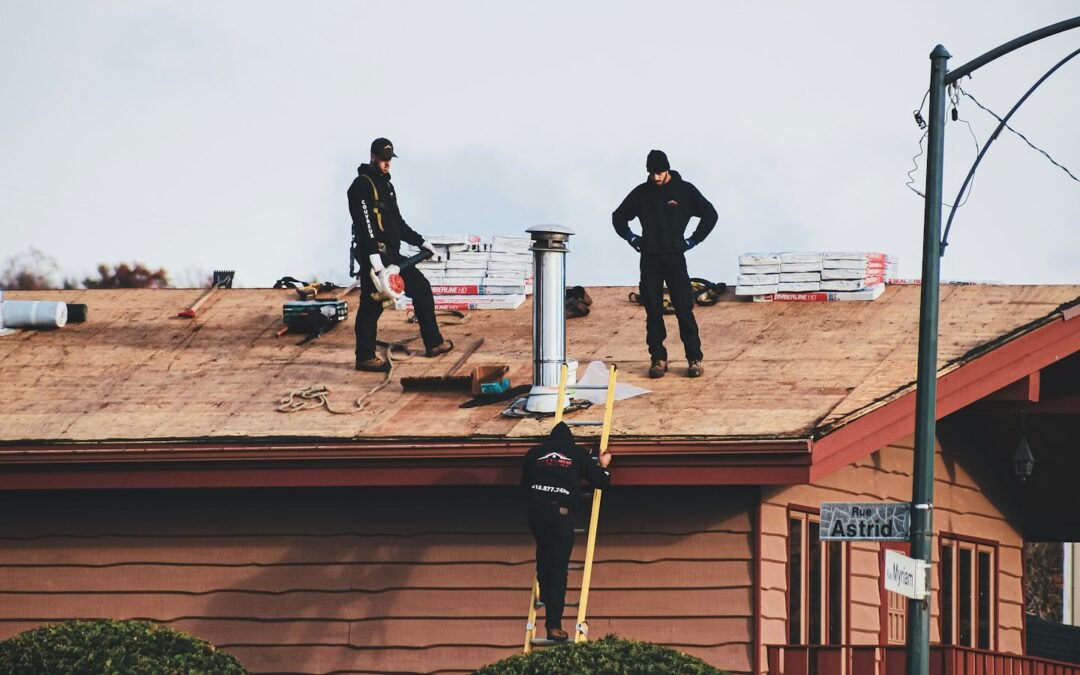
Every roof replacement has one moment of genuine uncertainty. The shingles and underlayment come off, and for the first time in 20 or 30 years, the wood underneath sees daylight. Most of the time it is fine. Sometimes it is not. Here is what roof decking is, why nobody can promise you its condition before tear-off, how we handle it when it needs replacing, and why you should never let anyone roof over a bad deck.
What the Decking Does
Roof decking, also called sheathing, is the layer of plywood or oriented strand board nailed to the rafters or trusses. Everything else sits on top of it: underlayment, ice and water shield, flashing, and shingles. The decking carries the weight of the roof system and of anyone walking on it, gives the shingle nails something to bite into, and ties the roof structure together so it resists wind as a single unit.
When decking is soft, delaminated, or rotted, nails pull loose, shingles lift in wind, and the roof surface sags between rafters. No shingle, however good, can perform on a deck that cannot hold a nail.
Why We Cannot Know Until Tear-Off
Homeowners sometimes ask why the estimate prices decking per sheet as needed rather than as a fixed number. The honest answer is that the decking is hidden under the roof, and there is no reliable way to see all of it. We can inspect the attic from below and catch staining, daylight, and obvious rot. We can walk the roof and feel for soft spots. But a sheet can be sound in the middle and rotted along one edge where a valley leaked for a decade.
So on every replacement estimate, we disclose the per-sheet price for decking replacement up front, in writing, before work starts. If we find bad sheets during tear-off, we photograph them, show you, and replace them at that disclosed price. If we find none, you pay for none. A bid that never mentions decking is either planning to roof over problems or planning a very different conversation once your old roof is in the dumpster.
Signs Before the Tear-Off
There are clues that often point to decking trouble, and we look for all of them during a free inspection.
- Soft or spongy spots underfoot when walking the roof, especially near valleys, chimneys, skylights, and eaves.
- Sagging between rafters visible from the street, which shows up as a wavy roofline.
- Staining on the underside of the deck seen from the attic, particularly dark rings around nail tips or along the eaves.
- Mold or a musty smell in the attic, which points to long-term moisture from a leak or from poor ventilation.
- A history of moss that was allowed to sit for years. Moss holds water against the roof, and that water finds its way to the deck.
If we see several of these on a home in Monroe or Lake Stevens, we will tell you to budget for some decking replacement before tear-off.
Older Decking: Thin Plywood and Skip Sheathing
Two situations come up often in the older housing stock around Puget Sound. The first is thin decking. Some homes built in the 1970s and 1980s used 3/8-inch plywood, which met code at the time but flexes noticeably, holds nails poorly after decades of moisture cycling, and often cannot meet current manufacturer requirements for a warranted installation. In those cases, the right fix is usually to overlay the old deck with new sheathing or replace it outright.
The second is skip sheathing. Homes that originally had cedar shake roofs were often built with spaced boards rather than solid decking, because shakes need airflow underneath. When a cedar roof is replaced with asphalt shingles, the gaps have to be covered with solid plywood or OSB first. Shingles nailed to skip sheathing have nothing under them between boards, and the roof will fail early. We see this regularly in Snohomish, Stanwood, and Whidbey Island neighborhoods where cedar was the standard for decades.
Why You Never Roof Over a Bad Deck
It is tempting, when the budget is tight, to ask whether the questionable sheets can just stay. Our answer is always no, and it is not about upselling. A shingle roof is warranted by the manufacturer as a system installed over a sound deck. Nails driven into rot do not hold, so the shingles above them are the first to go in a November windstorm. The rot keeps spreading under the new roof, and the next time it is opened up, there is more of it.
Replacing a few sheets during a re-roof adds a modest amount to the project. Discovering rot after a new roof is on means paying for the roof twice.
Get an Honest Read on Your Roof Deck
If you are planning a replacement and your home has any of the warning signs above, let us take a look first. Premier Roofing NW has been replacing roofs across the Greater Puget Sound area for more than 30 years, and we put decking pricing in writing on every estimate so you know exactly what to expect. Inspections and estimates are free, with no pressure. Discounts are available for seniors, military, and first responders; just ask when you schedule. Call us at (425) 247-0088.