
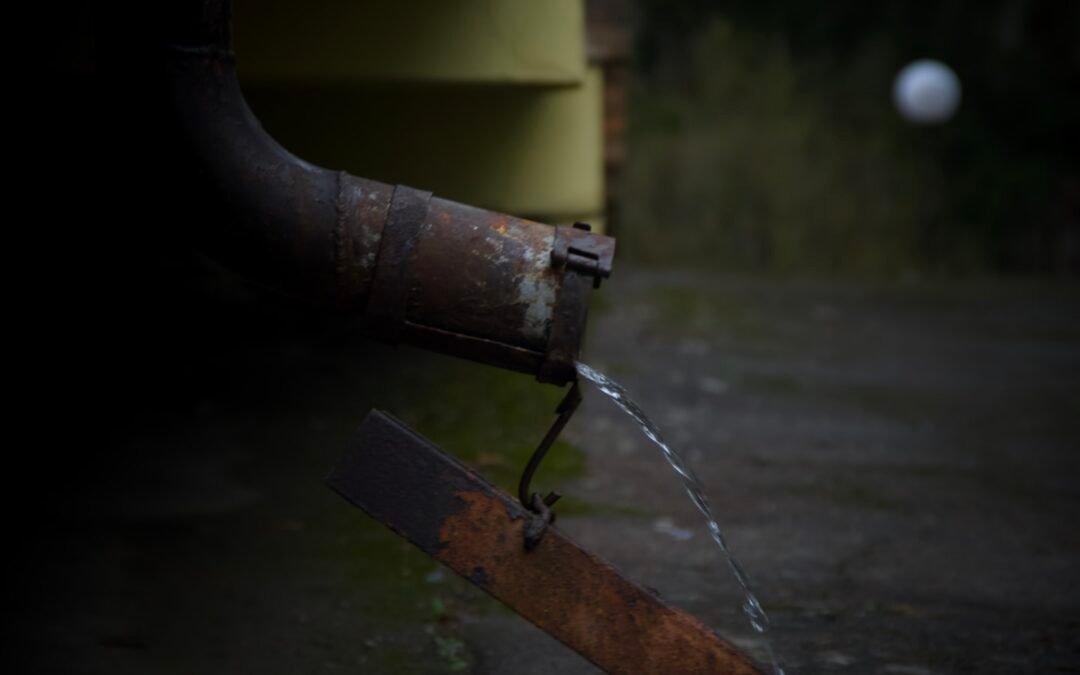
Stand in your driveway during the next good rain and watch the gutters. If water is sheeting over the edge instead of running to the downspouts, you are watching the first link in a damage chain that ends, months or years later, with rotted fascia, a soaked roof edge, and moisture in the crawl space. We see this chain complete itself in homes from Olympia to Renton every year, and almost every time it started with a gutter full of fir needles that nobody thought was urgent.
The Damage Chain, Step by Step
Clogged gutters do not cause one problem. They cause a sequence, and each step makes the next one worse.
Step one: overflow. A gutter packed with needles, leaves, and roof grit cannot move water to the downspout. Rain backs up and spills over both edges — down the face of the fascia and, more dangerously, backward toward the roof.
Step two: soaked fascia and soffit. The fascia board sits directly behind the gutter, and overflowing water runs across it constantly. Painted wood can shed water for a while, but weeks of saturation opens the grain, and rot follows. Once the fascia softens, the gutter hangers lose their grip, the gutter sags, and the overflow gets worse. The soffit above your walkways starts staining and peeling next.
Step three: water wicking under the roof edge. This is the step homeowners never see coming. When a gutter is full, standing water sits against the drip edge and the first course of shingles. Water wicks sideways and upward into the roof deck at the eave — the one part of the roof that was never designed to sit in a bath. We have opened up roof edges in Federal Way and Des Moines and found the bottom two feet of decking delaminated while the rest of the roof was in fine shape.
Step four: foundation pooling and basement moisture. All that water bypassing the downspouts lands at the base of your walls. Over a wet season, that means thousands of gallons dumped directly against the foundation. Soil erodes, water finds its way into crawl spaces and basements, and the musty smell shows up long before anyone connects it to the gutters two stories up.
Why This Is Worse in the Puget Sound Area
Most of the country gets rain in events. We get it as a lifestyle. With 150 or more rainy days in a typical year across Thurston County and King County, a clogged gutter here is not overflowing during the occasional thunderstorm — it is overflowing several times a week from October through May. Wood that never fully dries out rots faster. Soil that never drains stays saturated against the foundation.
Our tree canopy makes it worse. Douglas fir needles are small enough to slip past open gutters year-round, not just in autumn, and they mat into a dense sponge that holds water in the gutter even between storms. A gutter cleaned in September can be compromised again by January.
The Fix: Seamless Gutters, Properly Sized and Protected
Sectional gutters fail at their joints — every seam is a future leak and a snag point for debris. Our crews install extruded seamless gutters, formed on-site to the exact length of each run, so there are no mid-run seams to separate or drip. Sized and pitched correctly, a seamless system moves Puget Sound rainfall the way it should, straight to the downspouts and away from the house.
For homes surrounded by conifers — which describes most of Gig Harbor, Tumwater, and Lacey — we also recommend gutter guards as an optional upgrade. Guards keep the needle mat from forming in the first place, which means the system keeps flowing between cleanings instead of quietly overflowing every time you are not looking.
If your existing gutters are sound but sagging, leaking at a corner, or pulling away from soft fascia, repair is often the right call. We handle both new installations and repairs, and we will tell you honestly which one your home needs.
Break the Chain Before Fall
The damage chain runs on time, and late summer is when you can still interrupt it cheaply. Replacing a run of gutter and a section of fascia in August is a modest job. Waiting until the eaves have wicked water into the roof deck turns it into roof repair, and waiting longer than that adds foundation drainage to the list.
If your gutters overflowed at all last winter, or if you have not looked at them since spring, have them evaluated now. Premier Roofing NW has served the Greater Puget Sound area for more than 30 years, and our estimates are free. Call us at (425) 247-0088 and we will take a look at your gutters, fascia, and roof edge together — because in this climate, they fail as a system, and they should be protected as one.